
Andrea Gill, aka The TuneGirl, One of Techno's Most Unexpected Rising Stars
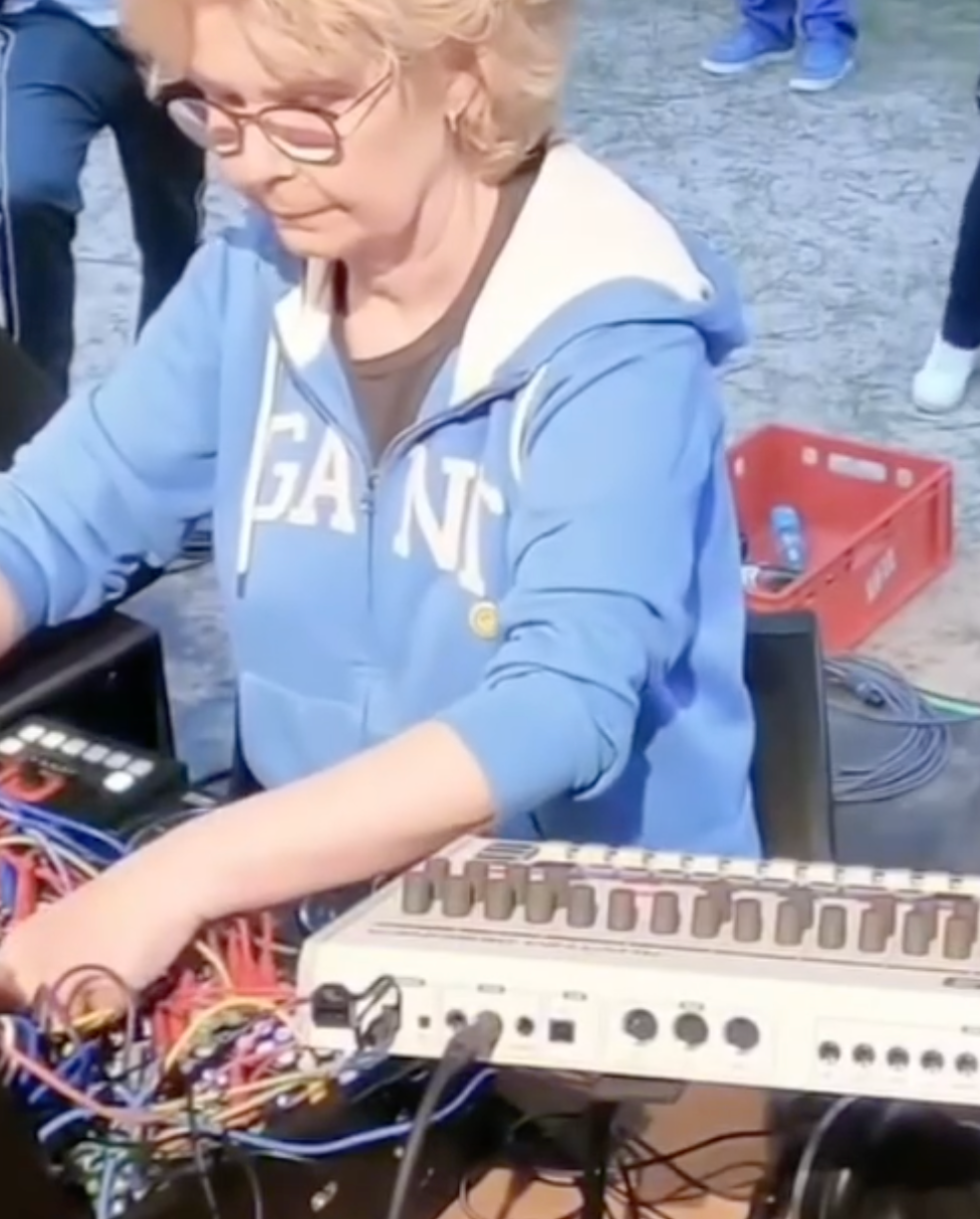
There's a specific kind of credibility that can't be faked in modular synthesis. You can't fake a live set improvised entirely in real time, no laptop, no safety net, in front of a crowd. Meet Andrea Gill, aka TuneGirl, one of techno's most unexpected rising stars. She made her debut at Awakenings Upclose festival in Amsterdam earlier this Spring. At 63 years old, the German electronic artist went viral for performing an entirely live, analog set using her own custom Eurorack modular synthesizer setup.
Andrea is no stranger to the music scene, she taught herself guitar and performed in bands during the 1970s and by the 80s she was already DJing funk, soul and disco records. Her first brush with synthesis came through a bandmate's Yamaha so by the 90s she was deep in Detroit techno drawn to the work of Jeff Mills, Robert Hood, Richie Hawtin, Steve Stoll, and K. Hand
After a decade's long break, she returned in 2009 and turned to software creation with programs like Abelton. She shortly found linear track arrangement a tedious obstacle to creative expression so she turned back to purchasing hardware again. At the time, she had no background in modular synthesis and basic subtractive synthesis. She bought a Eurorack case anyway, spent a year in self-directed study, and built her first functional synthesizer.
The Awakenings booking didn't come from a viral moment. It came from the quality of her live sets, credibility built within the modular community, and a body of recorded work that started gaining traction in 2022 with her remix for Edgar de Ramon on Univack.
She has been widely celebrated across social media as the "grandmother of techno" and a major inspiration for proving that creativity has no age limit. Electronic music tends to reward the myth of the prodigy and Tunegirl is proof that there is an alternative which is patience, craft, and 188 modules built one at a time.